OpenNHP's security philosophy is inspired by Bitcoin. Bitcoin guards one of the most valuable targets on Earth with two things: cryptography, which rests on mathematics rather than assumptions, and open source, which lets anyone audit every line. It has stayed standing because it never relied on secrecy.
OpenNHP follows the same formula, and the IETF Hackathon is how we put the second half into practice. Instead of claiming we're secure, we publish the code, run a live target, and invite researchers to prove us wrong. Every finding makes the protocol stronger. That is collective wisdom, and IETF 127 delivered plenty of it.
The hackathon ran November 14–15, 2026 at the Hilton San Francisco Union Square. The OpenNHP table carried the same challenge as our poster: Can you break it?
Special thanks to  @Stecodeven for helping coordinate the event.
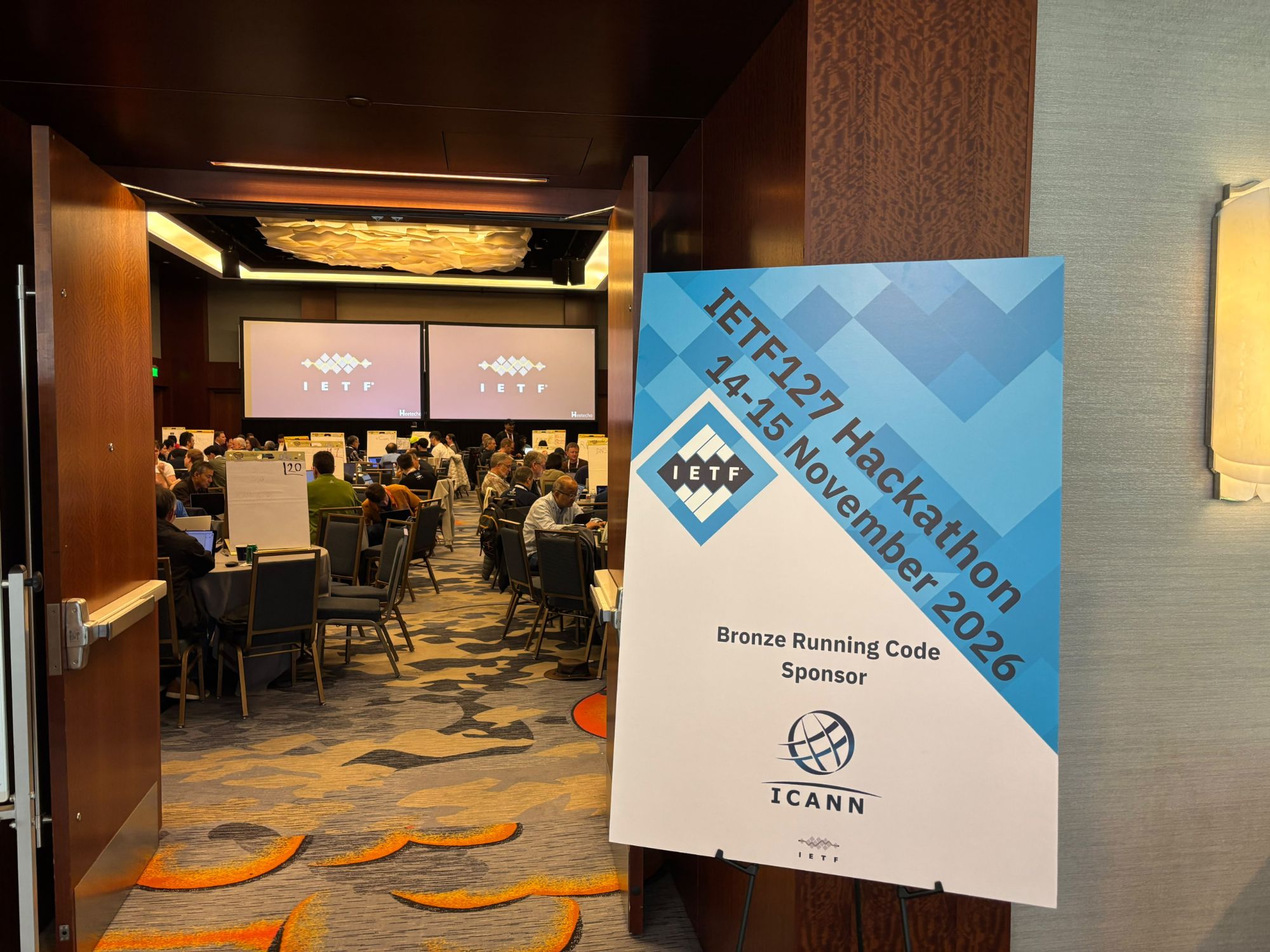
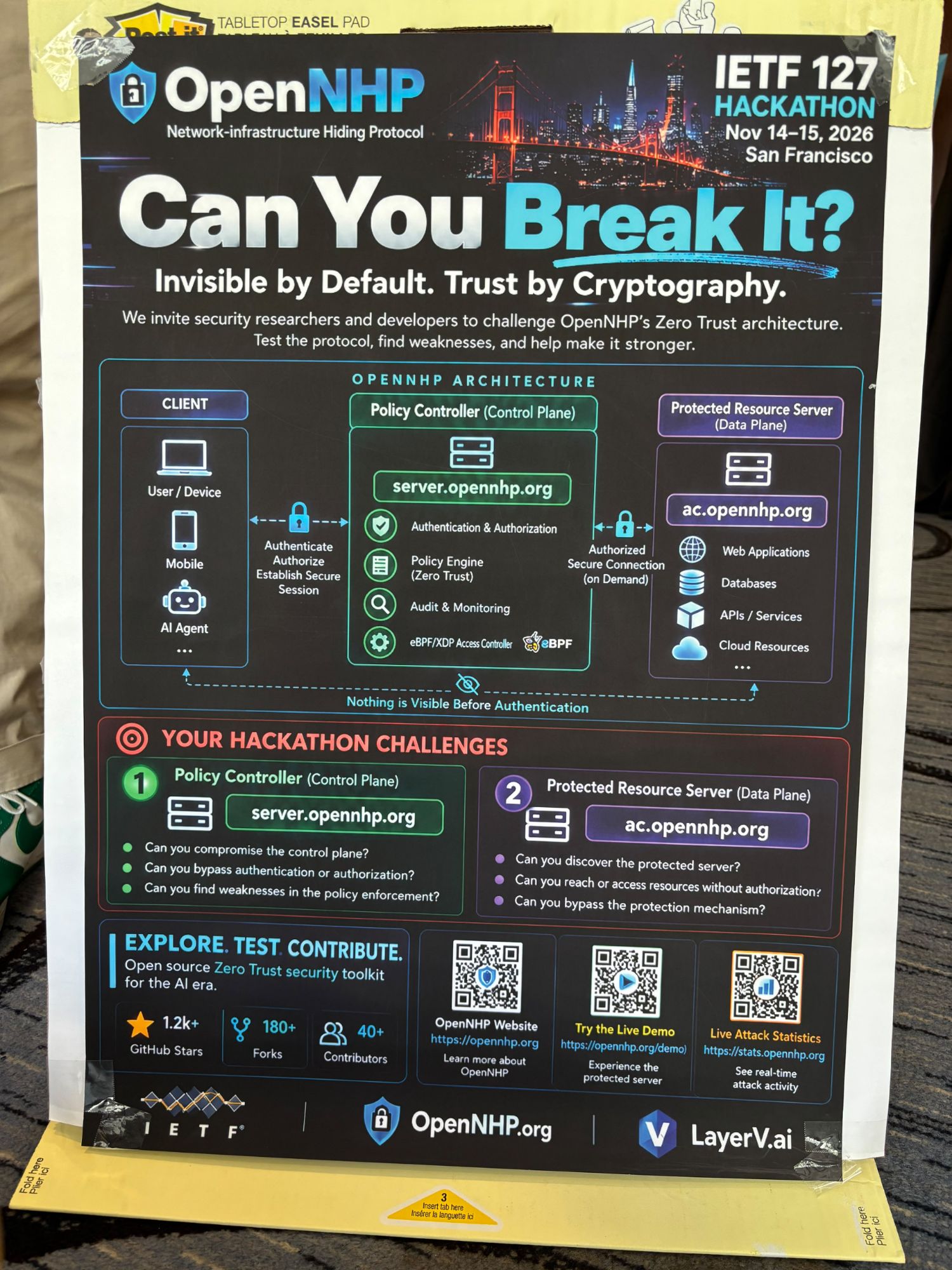
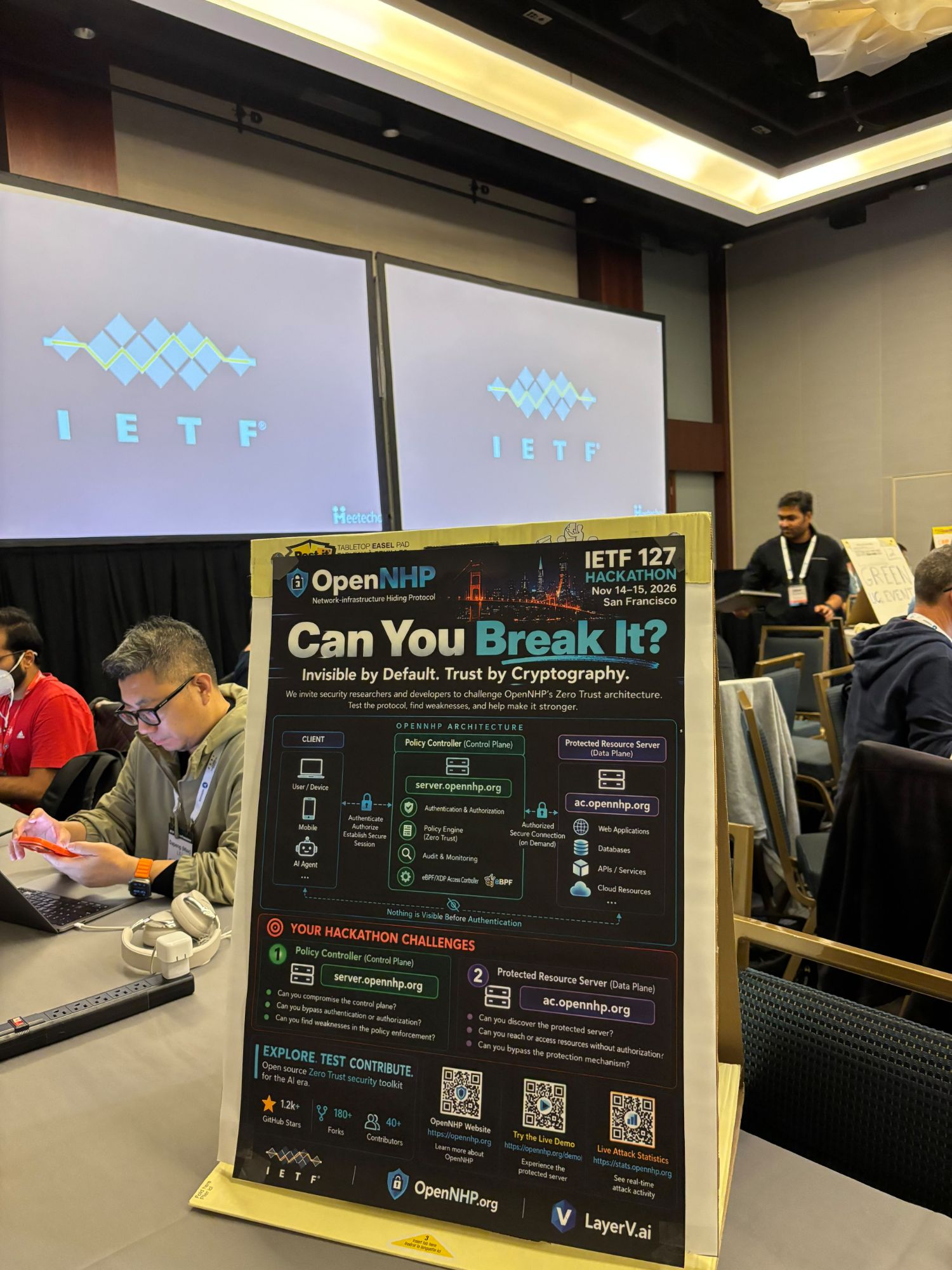
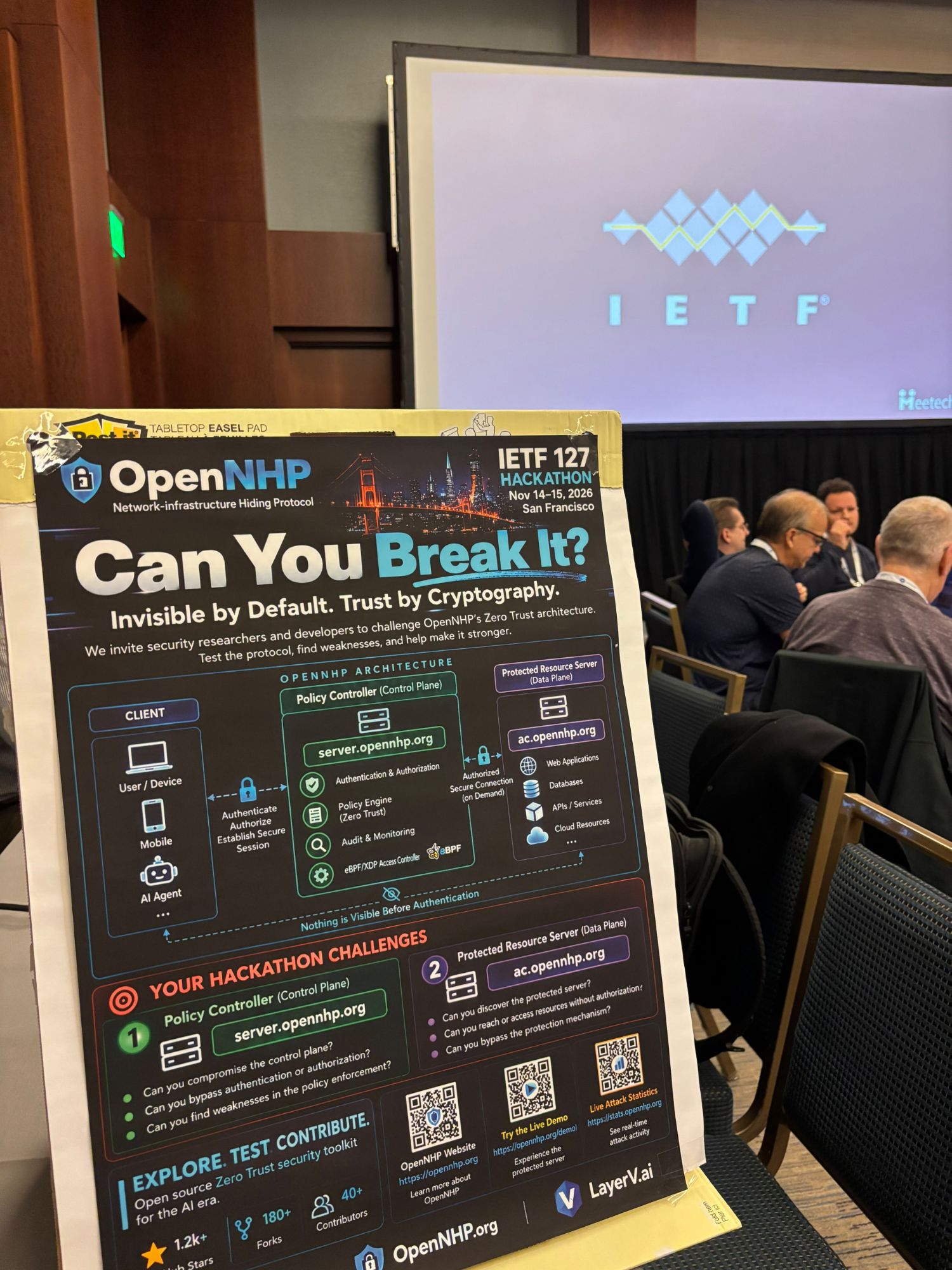
Our public demo kept running throughout the hackathon. Every scan and probe that hit the OpenNHP-protected server was dropped by its eBPF/XDP filter before it could connect, and logged on stats.opennhp.org.
Counted since October 16, 2026; figures update daily. Most traffic is automated TCP SYN scanning that never sees an open port.
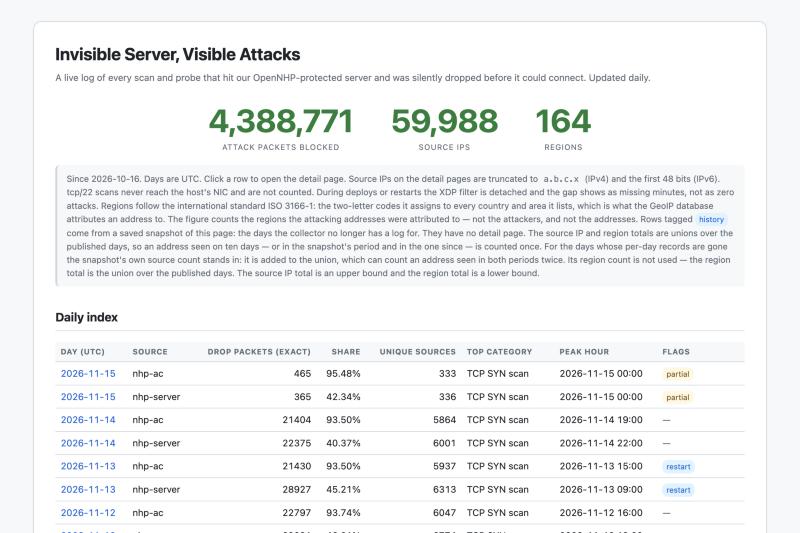
The stats.opennhp.org homepage during the hackathon. Click to open the live site.
The stats site is how we let anyone check our claims for themselves. It shows:
- Live totals of attack packets blocked, unique source IPs and regions, counted since October 16, 2026
- A daily index for both the NHP server and the access controller, with exact dropped-packet counts, unique sources, top attack category and peak hour
- Per-day detail pages with source IPs truncated for privacy
- Honest caveats, such as gaps during restarts showing as missing minutes rather than zero attacks
Security research reached us through many channels during the hackathon: advisories filed on GitHub, findings sent by email, and testing against the live demo. Rahul's stood out because it came as a full independent evaluation, with a defined scope, a reproducible lab setup, source-code analysis, an honest account of what held up, and concrete recommendations. That's why we chose it as the highlighted research of IETF 127.

Rahul served as an invited independent reviewer. He built a private lab running the full OpenNHP v1.0.2 stack (server, access controller, protected app and agent) and put the protocol's core promise to the test himself. He did this work in a personal capacity; the findings are his own.
| Area | Result |
|---|---|
| Default-deny invisibility | ✓ Held up: the protected app was unreachable before a knock, and the access rule closed on its timer afterward |
| Authenticate-before-connect | ✓ Held up: a valid knock opened a short-lived path as designed |
| Freshness check | ✓ Held up: a stale captured knock was rejected |
| Knock replay protection | ✕ Issue found: replay handling within the freshness window needs hardening |
The replay issue was also reported independently by other researchers through GitHub Security Advisories, which is exactly the kind of convergence open review is meant to produce. It is fixed in v1.1.0. Rahul's recommendations shaped the fix:
He also found a small Docker quick-start build issue and offered the fix. Thank you, Rahul, for a rigorous and generous review.
Researchers submitted 24 vulnerability reports through GitHub Security Advisories, covering about 15 distinct issues: 7 reports rated critical, 15 high and 2 medium. Fourteen arrived during the hackathon window. Several issues were found independently by more than one researcher, the strongest signal open review can give.
During the hackathon, including eight reports from Leander Metcalf (@tentpegbob):
 @tentpegbob
 @B1ueD0g
In the run-up to the hackathon:
 @kta1kri 3
 @28Hus 1
 @Trenyx 1
 @runboyxyz 1
 @EQSTLab 1
 @avishaigonen-pluto 1
 @yotampe-pluto 1
 @geo-chen 1
 @DavidCarliez 1
All of these issues are fixed in OpenNHP v1.1.0, released November 19, 2026. Each advisory will be published with credit to its researchers, giving users time to upgrade first. We'll publish them no later than 90 days after the first report.
Counts show reports per researcher; three duplicates are excluded.
Between October 15 and November 19, these contributors merged 39 pull requests into OpenNHP, plus 38 dependency updates from Dependabot:
 @haochangjiu
 @fengyily
 @windcbf
 @justingreerbbi
 @craftleon
 @AZDane
 @justin-layerv
Many of these PRs are the security fixes that went into v1.1.0: @haochangjiu removed the hard-coded session key, the shipped KGC master key and the unused Key Broker Service, added TLS for remote configuration, a fail-closed option for the access controller and stricter address enrolment (#1865, #1864, #1863, #1866, #1881, #1883); @craftleon fixed knock replay from new connections (#1868); and @fengyily corrected the eBPF whitelist byte order (#1884). Other highlights include concurrency fixes from @haochangjiu (#1843, #1848), a new eBPF/XDP internals guide and the stats pipeline from @fengyily (#1845, #1823), etcd client lifecycle fixes from @AZDane (#1847), and mobile SDK work from @justingreerbbi (#1809).
Cryptography + Open Source + Collective Wisdom.
Thank you to everyone who attacked, reviewed and coded with us at IETF 127.
Questions? Contact us at [email protected].